
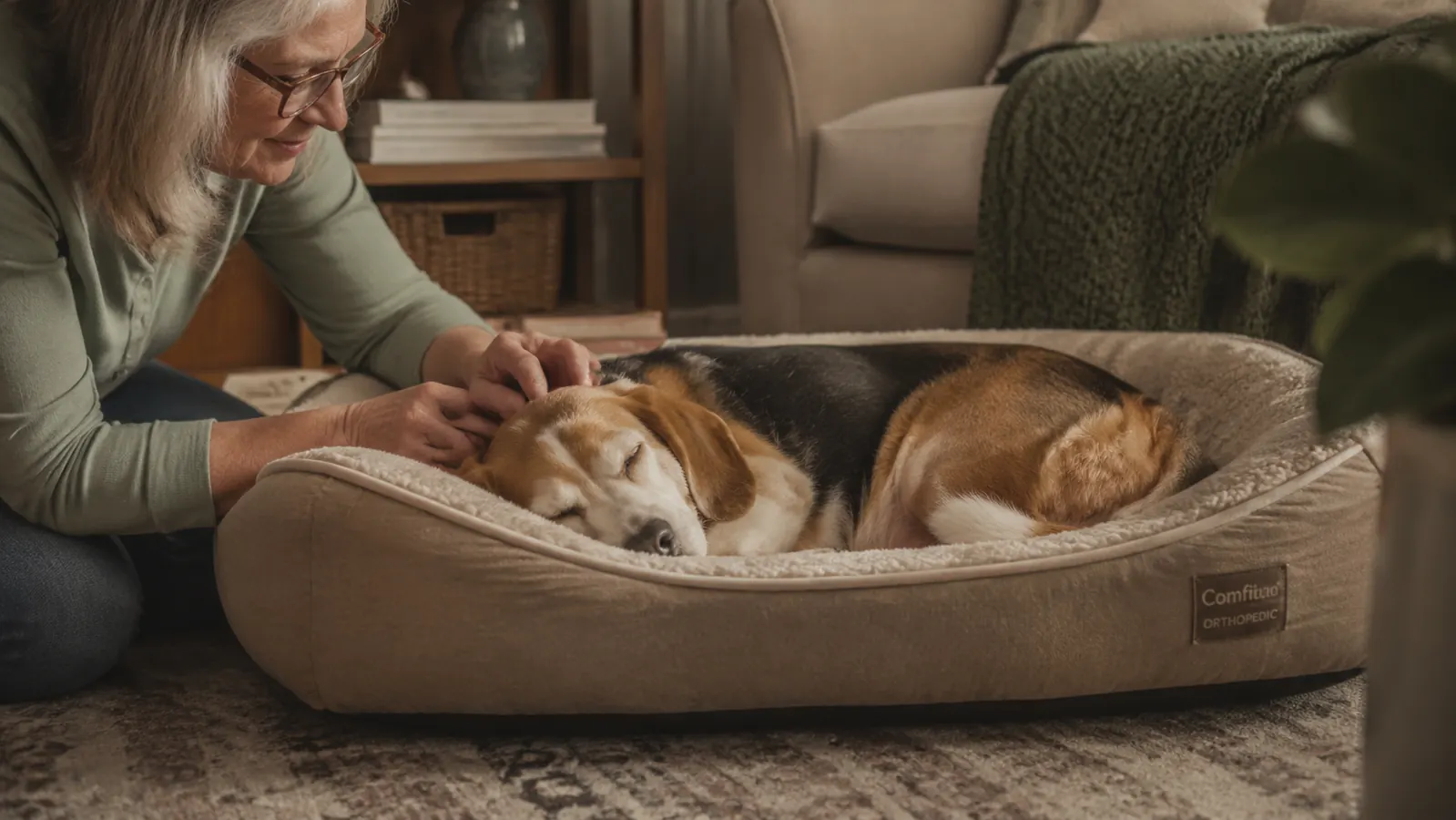
Rocky is 13, a beagle mix who comes in just over 24 pounds on a heavy day. His arthritis started in the shoulders, and for months I watched him circle his old flat bed, step back, circle again, then tuck himself into a guarded half-sleep with one leg folded awkwardly under his chest. A senior dog does not tell you he is uncomfortable. He just gets restless, or stops jumping onto the couch, or picks the cold bathroom tile over his pad because the floor feels better than a cushion that has gone lumpy. For a dog his age, the surface he sleeps on stops being furniture and starts being part of his care, the same way his food and his joint pills are.
After the third lost night in a row, I stopped guessing and started measuring. I had just switched Rocky to a Bedsure orthopedic bed, and I wanted to understand exactly why that one settled him when the first two did not. What I found is that almost every mistake comes down to five things you can check in ten minutes, before you spend any money. This is the checklist I run now, and I wish someone had handed it to me before I bought the beds that ended up donated. The discouraging part is how simple the answers are once someone lays them out, and none of it takes an engineering degree or a second trip to the vet.
The good news is that a decent orthopedic bed does not have to be complicated, and it does not have to be the most expensive one on the shelf. Budget matters, I get that, I am the same way. What separates the beds that work from the beds that become dog pillows is the list below. Run it top to bottom and you will walk away with the right bed for your dog, your floors, and your washing machine.
The orthopedic bed I run this checklist against
Bedsure's orthopedic bed has a foam core that holds its shape, a removable washable cover, and a bolster Rocky actually leans on. If you want a solid place to start taking your own measurements, this is the bed I would buy again.
Amazon Check Today's Price on Amazon →Step 1: Measure Your Dog Lying Down
Manufacturers label beds small, medium, and large, and those labels mean almost nothing. A small bed from one brand fits a different dog than a small bed from the next, so you cannot compare two listings by the letter on the box. The only measurement that matters is your dog stretched out. Measure from the tip of his nose to the base of his tail while he is lying flat and relaxed, not curled up into a ball. Measure him while he naps, or have a helper hold a treat steady for the few seconds it takes.
Add six to eight inches to that number, and that is the length you actually want in the bed. Rocky naps in a tight curl during the day, which is why I bought a small bed first and it looked perfect in the listing photo. But a senior dog needs room to fully extend one leg behind him while he sleeps, to take pressure off a sore shoulder. A bed he has to stay curled in does him no favors, however plush it looks. Give him a little extra width too, because a dog who settles then wiggles his hind end will push a too-narrow bed until the foam bunches against the wall.
Write the number down and hold it against the size chart before you add anything to the cart. Bedsure lists its beds by mattress length, so I matched Rocky's stretched-out measurement to the chart before I ordered, not after it arrived a few inches too short. That one habit stops more bad purchases than any other single step on this list.
Step 2: Turn It Over and Check the Foam
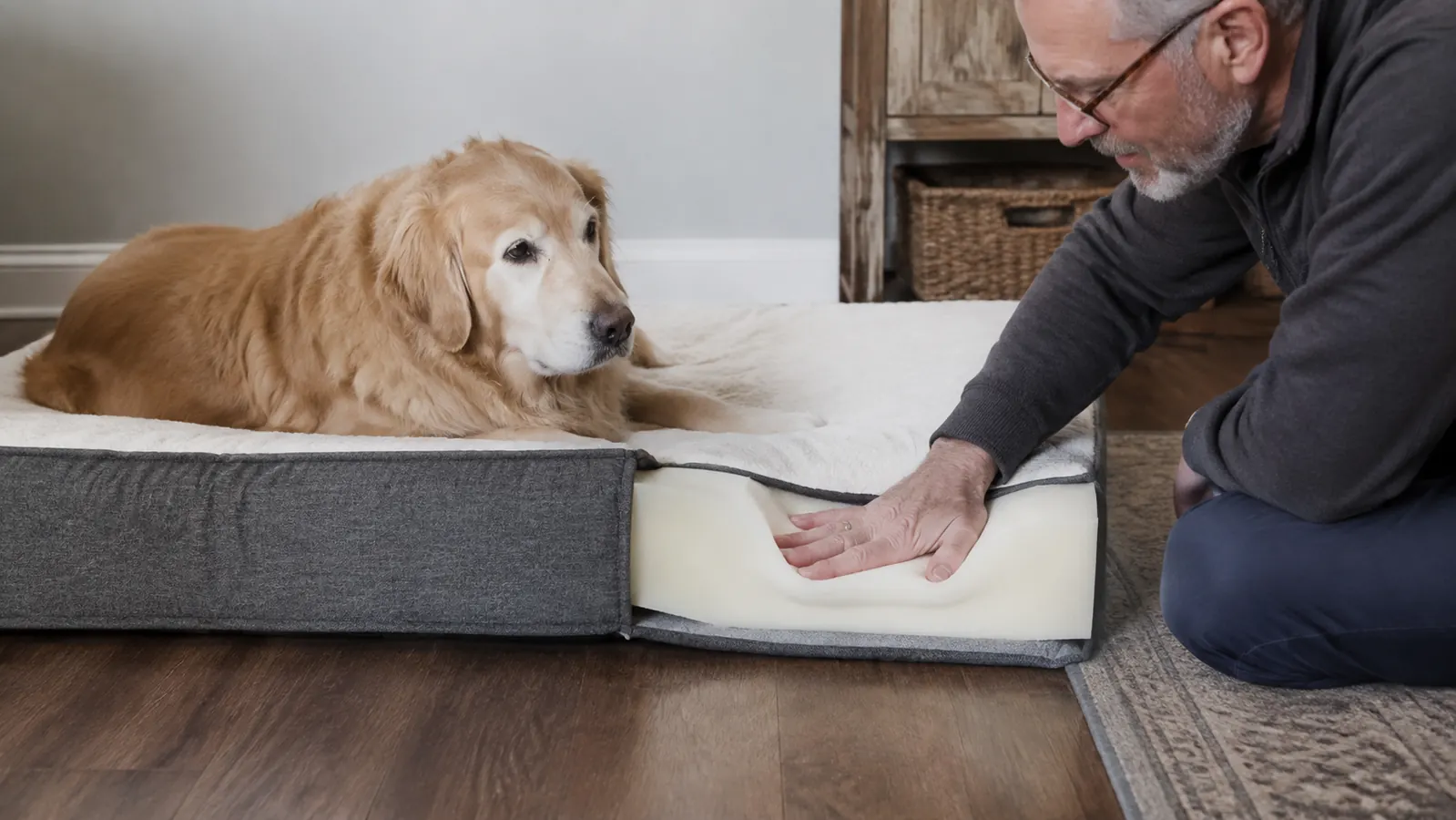
The word orthopedic gets thrown around loosely, and honestly it has started to mean very little. What it should mean in practice is a supportive foam core thick enough that your dog's hip does not sink to the floor. The bed Rocky sleeps on now has a solid base, and when I press my hand into it, I can feel it spring back slowly instead of collapsing flat onto the floor. That rebound is the whole point of the word.
Push on the cover before you buy, in whatever way you can, even if that just means reading how the manufacturer describes the core. If your knuckles would meet the floor through the bottom in less than a finger's width of foam, that is a cushion, not an orthopedic bed, whatever the listing claims. When you press a real orthopedic core you should feel resistance that builds, not a soft give that sinks to the table underneath. A firmer, denser core from a brand that has been making pet beds for a while beats a plush foam that bottoms out in a month.
Match the foam to the weight of your dog, not just to his age. Rocky is 24 pounds, so he does not need the tallest foam on the market, and a lighter bed is easier for him to climb into. A 60 pound Labrador in the same house would need noticeably more support. The right thickness follows the dog, and there is no single correct answer that works for every body. A core made of one solid slab of support foam holds up far better than crumbled bits glued together, which pack down into a lumpy mess and need replacing before you expect it.
I can press my hand into the foam and feel it spring back slowly instead of collapsing flat. That rebound is the whole point.
Step 3: Demand a Truly Removable, Washable Cover
This is the step a first-time buyer skips, and it is the one that decides whether the bed survives the year. An aging dog leaks. He dribbles when he drinks, he can have an accident in his sleep, he drags in mud from the yard, and his skin flakes no matter how well you groom him. If the cover does not come off and go into the machine, the bed is a sponge you cannot clean, and it will smell like it within a month. Once it starts to smell, an older dog often refuses to lie in it, and you are back where you started with a second unused purchase. Keep a pack of odor-absorbing granules under the sink and you can stretch out the time between washes without anyone in the house turning up their nose.
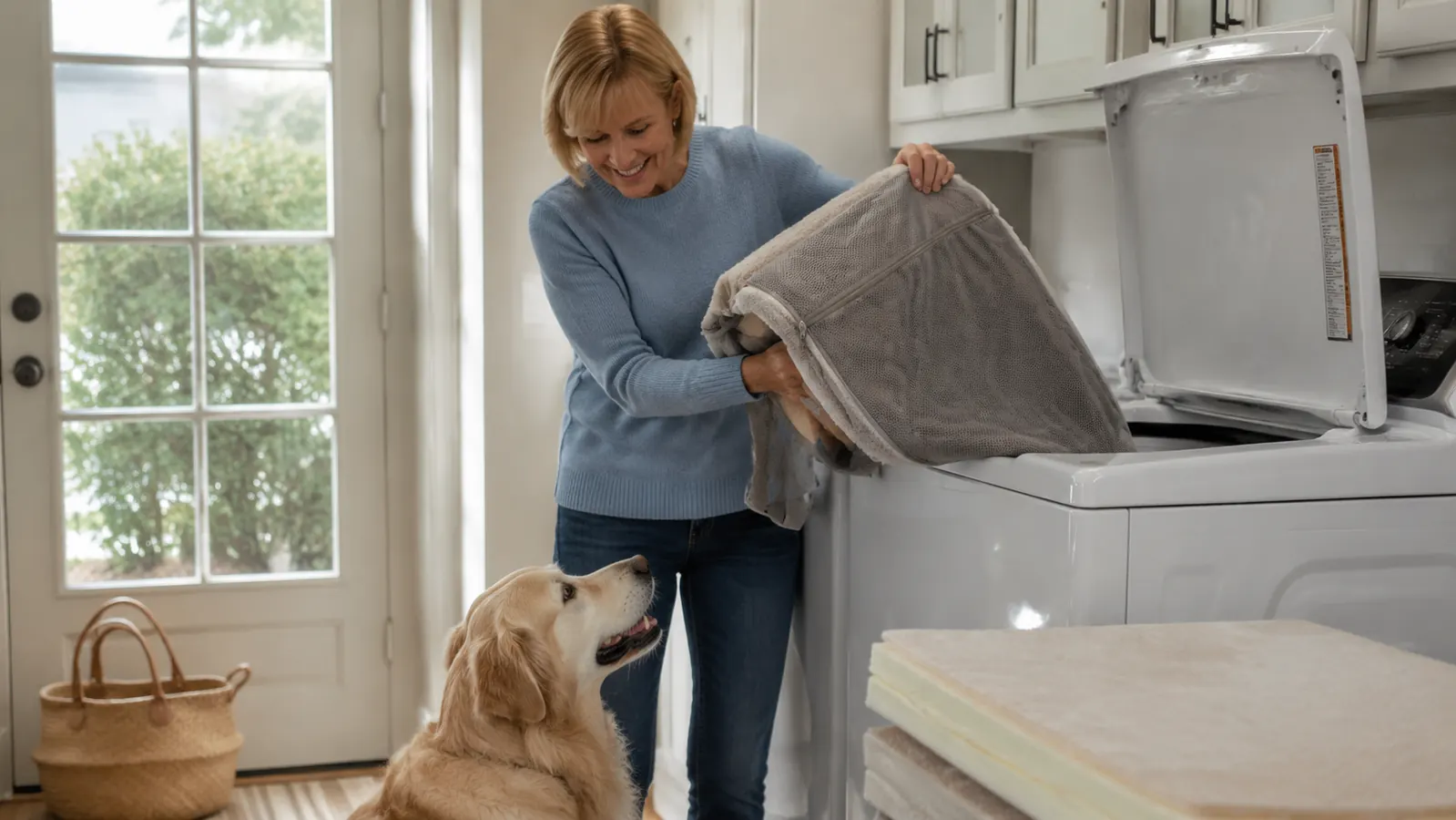
Practically zip it off in your head before you buy. A frustrating number of beds say washable but hide a zipper stitched under a flap, or a cover that only wipes clean, or a foam core you are told not to get wet. The Bedsure cover pulls all the way off, survives a normal warm wash, and I dry it on low without issue. That single feature is why Rocky's bed still smells like the house and not like the dog, four months in.
Use the cover as your final tiebreaker between two otherwise similar beds. If you would not put a cover in your own laundry, you will not wash it, and neither will anyone else in the house. Between two equal foam cores and two equal prices, the washable cover is the one that keeps a senior dog's bed clean enough to actually keep using. In the months between machine washes, I keep a folded throw blanket over the top to catch the fur and any small spills, so I can shake it out instead of unzipping the whole bed every week.
Step 4: Decide on the Bolsters
Most orthopedic beds come either flat or with raised edges, called bolsters, around one or two of the sides. Older dogs with arthritis often want something to rest their chins on when they lie down, and they like a low back to lean against while they sleep. A bolster lets a dog prop his head so his airway stays open and his neck does not fold into an awkward angle for hours. At the same time, a very stiff dog sometimes struggles to climb over a high edge, and a bed he cannot enter easily becomes a bed he ignores.
Let your own dog decide by watching how he sleeps for a week. Rocky rests his head on the raised edge when he settles, so the bolster on my Bedsure earns its place. A dog who flops forward onto the floor in a flat heap is probably happier with a bed where the edge is low or absent altogether, because the flat surface matches how he actually rests. Watch him after he comes in from outside too, because a dog who circles to line his back up against a sofa cushion is telling you he wants something to lean on. That little bit of observation costs you nothing but a week of paying attention, and it saves you from guessing wrong.
If you are not sure which one he is, buy a bed with a bolster on one side and open space on the other. That gives him the choice, and a senior dog values being able to get in and out without a step over a wall of stuffing. A one-sided bolster covers both habits without forcing you to guess.
Step 5: Think About Where the Bed Will Sit
The last mistake is buying a genuinely good bed and then putting it in a spot the dog will not use. A senior dog follows the household. If you spend your evenings on the couch, that is where your dog wants to be, not on a bed he has to cross the room to reach, no matter how supportive it is.
Check the flooring under the spot before you commit. A bed on hard tile or wood needs a non-slip base, or the whole thing scoots across the floor every time your dog climbs on, which is discouraging for a stiff animal on a bad morning. Put the bed where the dog already sleeps, not where you think he should sleep, and keep it out of the coldest draft near a window. Older dogs feel the cold more, and a bed in a draft means he will choose the warmer spot on the rug instead.
I keep Rocky's bed in the corner of the living room closest to where I sit in the evening. It is in sight of everyone, warm, off the tile, and he climbs into it every single night without being coaxed. That is the whole test, a bed in the right spot gets used, and a bed in the wrong spot collects dust.
What Else Helps
A supportive bed is one leg of the stool, not the whole thing. Rocky also gets a daily joint supplement that the vet recommended, and I keep a soft rug over his usual standing spot on the tile so his front leg has traction when he first gets to his feet in the morning. Taken together, these make the difference between a dog who needs to brace himself and a dog who simply stands up. I also give him a gentle warm walk before he settles, because a few loose minutes loosen the stiffness and he drops onto the bed ready to sleep.
Mobility changes are slow, and you will not notice a bed working in a day. What you notice instead is quieter: no more circling at bedtime, longer stretches of sleep, and a dog who gets up in one smooth motion instead of pushing himself up with his front legs. None of it happens overnight, but it happens.
If you have been putting the purchase off because the research feels overwhelming, the simplest rule is to skip the marketing and run this list: measure your dog stretched out, check the foam, unzip the cover, decide on the bolster, and put the bed where he already sleeps. Ten minutes of checking beats another sleepless night for both of you. A bed is not a cure, and I am not pretending an old dog stops hurting the day a box shows up, but the floor under him while he rests is one thing you can fix today without a single vet appointment.
A bed your senior dog will actually use
Four months in, Rocky settles into his Bedsure bed the moment I pull it flat at night. A solid foam core, a cover I can wash in the machine, and a bolster he leans on. If you are done guessing at sizes, this is the bed I would measure your dog for first.
Amazon Check Today's Price on Amazon →